
By Sridhar Reddy
Even in a dysfunctional and divided political climate, both a Republican and Democratic-run Washington have invested significant capital and political will to win the AI race against China. Despite ongoing debates about how to properly regulate AI, the Trump administration’s position is centered around its AI Action Plan, which promises to secure America’s leadership in artificial intelligence by boosting research, reshaping rules, and increasing domestic investment in semiconductors.
As usual with AI policy, these moves are significant but incomplete: American leaders are still refusing to address a major loophole that threatens to undermine all our progress to date. It is time for that to change. America needs to close the RISC-V loophole currently being leveraged by China.
It may be true that this appears to be a narrow and somewhat niche issue, but RISC-V is anything but narrow: it has significant implications for our national and economic security. The U.S. needs to weave RISC-V into export policy, set standards for how it’s deployed in critical systems, and invest in secure alternatives so our openness isn’t exploited by key adversaries.
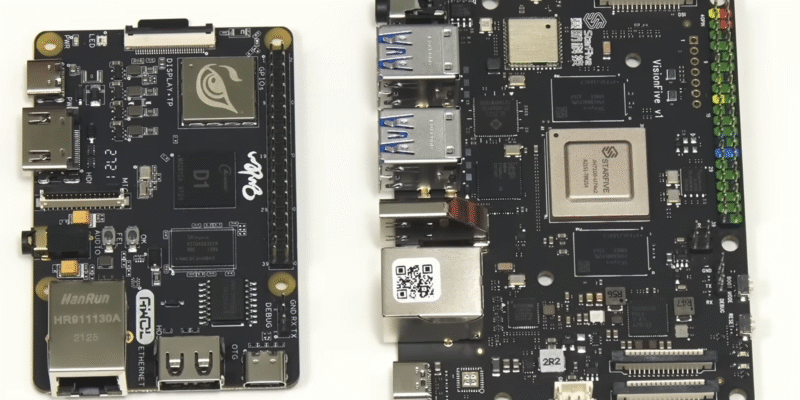
So, what exactly is RISC-V? Pronounced “risk-five,” it’s an open-source, royalty-free architecture that began as a research project at the University of California, Berkeley in 2010. Unlike proprietary chip architectures like Intel’s x86 or Arm’s infrastructure, RISC-V is free for anyone to use and modify.
In theory, that sounds good. And RISC-V is indeed popular with academics and startups who want to design chips without paying licensing fees. And there are obvious advantages. Besides cutting costs by eliminating licensing fees, RISC-V also allows customization, as designers can add extensions or modify features without being locked into one company’s standard. And the market is growing fast: analysts expect RISC-V to expand from about $2.3 billion in 2025 to more than $8.5 billion by 2030.
U.S. companies are paying attention. Andes Technology, for example, has opened a design center in the U.S. to focus on high-performance RISC-V CPU development. AheadComputing, a startup founded by former Intel executives, recently secured $21.5 million to build RISC-V processors aimed at AI workloads. NVIDIA has even extended support for RISC-V in its CUDA software platform, giving the architecture visibility within one of the most widely used ecosystems in computing.
For the most demanding tasks, like supercomputing, advanced AI models, or large-scale data center operations, RISC-V designs lag behind competitors. The surrounding ecosystem of software tools, debugging frameworks, and developer support is improving, but remains less mature than other proprietary designs. And because anyone can modify the architecture, there is risk of fragmentation: multiple incompatible versions, some more secure than others, circulating without consistent oversight.
This matters for two big reasons: economics and national security. Economically, RISC-V could change who leads in semiconductors. By removing barriers to entry, it gives new players and entire countries a shot at building competitive chips.
That has already caught the attention of policymakers in Beijing. State agencies and sanctioned research institutes have already invested more than $50 million in RISC-V projects since 2018, while Chinese startups have raised more than $1.1 billion. That kind of investment signals that Beijing sees RISC-V not as a side project but as a strategic tool to sidestep tough export controls and tech restrictions implemented by both parties.
On the security side, the openness that makes RISC-V so appealing also creates immense risk. Without a single governing authority or licensing structure, it’s harder to guarantee the trustworthiness of every implementation. Researchers warn that open architectures can be easier to manipulate, leaving room for hidden vulnerabilities or backdoors. When chips underlie everything from telecom networks to defense systems, that’s not a hypothetical concern. If adversaries build or influence RISC-V standards, it could complicate our supply chains and weaken trust in the hardware running critical infrastructure.
Despite all this, Washington remains largely silent on RISC-V. It doesn’t make headlines or control the topic of conversation in the same way that AI has, yet its influence is spreading quickly in ways that will shape the next decade of technology.
That’s why the U.S. needs to take advantage of the current conversation around AI and the future of technology. Policymakers should explicitly factor RISC-V for reliability and security so that the United States can set the standards instead of scrambling to follow them. RISC-V has moved from Berkeley lecture halls to boardrooms in Beijing and Silicon Valley. It might not yet be a household name, but its role in the global semiconductor landscape is only growing.
Treating it as an afterthought is no longer an option. Washington needs to pay attention to RISC-V as it becomes the foundation of a technological future that will affect both our economic leadership and our security.
Sridhar Reddy is a former advisor to the NASA Administrator.