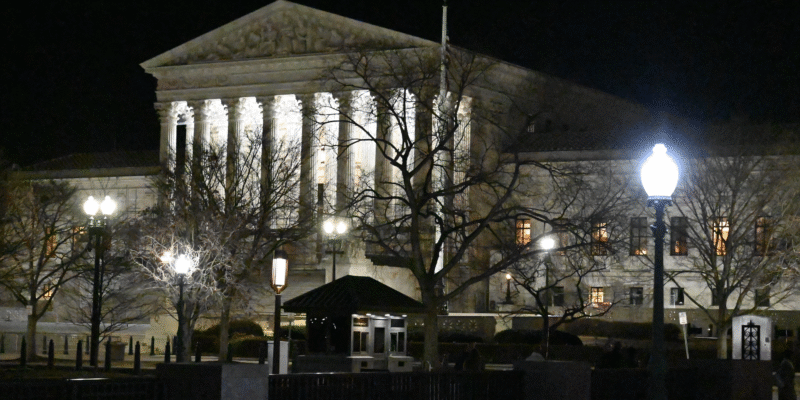

The Supreme Court's 6-3 decision striking down Louisiana's congressional map sent shockwaves through Democratic circles today, with two prominent party voices quickly taking to social media to condemn the ruling and call for sweeping reform.
The court's conservative majority, in an opinion authored by Justice Samuel Alito, upheld the Voting Rights Act in principle while simultaneously ruling that Louisiana's redrawn majority-Black district constituted an unconstitutional racial gerrymander.
The liberal minority, led by Justice Elena Kagan in dissent, argued that the decision effectively dismantled the civil rights law's core protections.
State Representative James Talarico (D-TX) responded with a direct pledge, announcing his intention to pursue federal legislation if his party returns to power. "When we win, the first bill I'm filing is a national ban to end gerrymandering once and for all," he wrote on X.
Democrats Fight
Representative Christian Menefee (D-TX) offered a more detailed breakdown of what he sees as the ruling's practical consequences.
In a thread post, Rep. Menefee argued that the decision makes it nearly impossible to prove racial gerrymandering in court, because states can now attribute racially motivated map-drawing to partisan strategy rather than face legal consequences for doing so.
"As long as its legislators avoid saying the quiet part out loud, and instead say the magic words: 'we did it for partisan reasons,'" they are effectively shielded from challenge, Menefee argued.
Menefee pointed to Texas as a case study, describing a recent redistricting fight in which a bipartisan three-judge federal panel, after nine days of testimony, nearly two dozen witnesses, and thousands of exhibits, ruled that the state's congressional map was a racial gerrymander.
The Supreme Court overturned that ruling, accepting Texas's argument that the changes were driven by partisan rather than racial motives.
"If that's not enough, what is?" Menefee wrote, arguing the new standard is practically unachievable for plaintiffs.
Both men closed their remarks by calling for broader structural change. Menefee called for national redistricting reform and Supreme Court reform, while Talarico framed the ruling as motivation for Democrats to win elections and act quickly once in office.