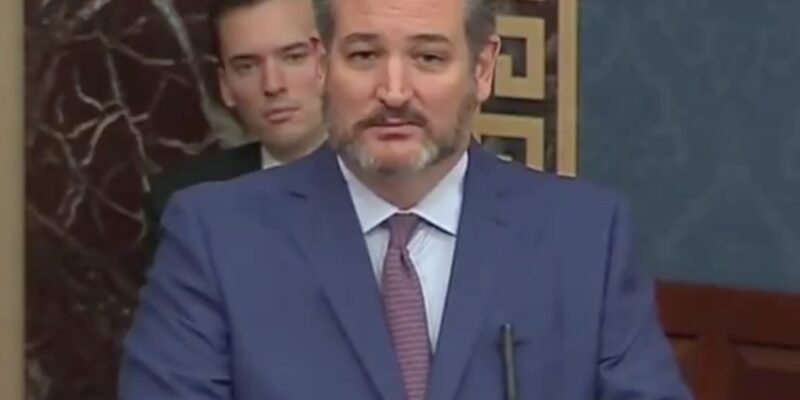

Following a United States Senate hearing focusing on the impact of Muslim Brotherhood networks led by Senator Ted Cruz (R-TX) earlier this week, his Democratic colleagues are pushing back on his criticism, putting a Michigan primary victory at the center of a national Islam debate.
During Sen. Cruz’s hearing under the Senate Judiciary Committee, he highlighted several concerns regarding the rise of Sharia Law. The hearing comes as anti-Islamic rhetoric becomes increasingly popular among Republicans’ midterm campaign efforts and follows Democratic Candidate Abdul El-Sayed's (D-MI) victory in Michigan's U.S. Senate primary. This win makes El-Sayed the first Muslim nominee of a major party for the U.S. Senate in the state's history.
According to Vinny Minchillo, a republican strategist based in Plano, Texas, opposition to Islamic religious law will be a “winner” in Texas Republican primaries.
“It is playing as well as anything I have ever seen with Texas Republican voters,” Minchillo said. “It’s solid gold.”
But other members of Congress are pushing back on the hearing’s greater implications. Sen. Sheldon Whitehouse (D-RI) denounced Sen. Cruz’s hearing for what he called an attempt to target Muslims for political gain
“Scapegoating Muslims may be a Texas Republican strategist’s idea of ‘solid gold’ to whip up their voters, but Democrats have no intention of indulging this political creepshow…” Sen. Whitehouse said. “Our focus is the costs families face thanks to rampant, non-stop Trump corruption.”
With the midterms looming, Sen. Cruz also used part of the hearing to highlight what he described as a significant victory for Democratic Socialists in Michigan. The outspoken anti-corporate PAC El-Sayed defeated Representative Haley Stevens (D-MI) by just one percentage point in Tuesday's Democratic primary.
“Perfect timing for this hearing,” Sen. Cruz said. “[That] probably explains why no Democrats are here and don’t intend to attend, because their campaign is now openly embracing terrorist organizations waging war on America.”
Sen. Haley Stevens had tens of millions of dollars in outside support from AIPAC-affiliated groups and other super PACs behind her campaign, while Abdul El-Sayed relied largely on grassroots donors and small-dollar contributions.
“Behind El-Sayed's political rise sits a much bolder and more entrenched institutional network,” he said. “At the center of this sprawling network is the Council on American Islamic Relations.”
President Donald Trump also took aim at El-Sayed, saying he is a “man of hate” and that his nomination reflects the Democratic Party's shift toward the far left.
The next morning on CNN, El-Sayed addressed the mounting criticism he’s received from Republicans in Congress and the president.
“I think the thing that’s most important is that people are tired of politicians who are more focused on attacking each other than on actually solving the problems that working people face,” El-Sayed said.