
As President Donald Trump touched down in China earlier today, lawmakers in Washington, D.C., are weighing how the United States can compete with its global rival in energy and power innovation without burdening local communities.
At a House Energy and Commerce subcommittee hearing earlier today, committee members considered how to expand transmission infrastructure to meet growing power demands while efficiently delivering reliable, affordable energy to consumers.
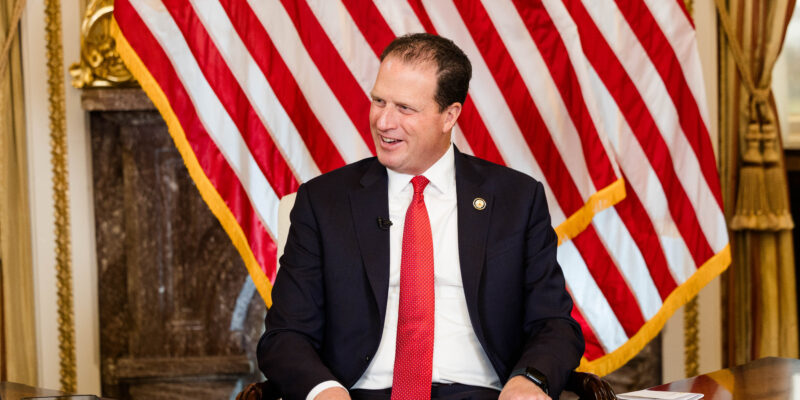
Rep. August Pfluger (R-TX) said he supports every aspect of this aim to deliver more power to communities, but he also said there is more to this conversation than just meeting local energy needs.
“This is a competition with the Chinese Communist Party that would really like to take data centers, in particular, back to the mainland of China, instead of allowing them to be here,” Rep. Pfluger said.
Although Pfluger said the U.S. must remain a key competitor in the “race for AI dominance,” ensuring state leaders and communities have a say in where and how transmission line projects are built is just as vital.
“When lines are built and they go through private land, I think the onus is on all of us to really tell that story about what we're doing,” Rep. Pfluger said. “And there's a lot of concern back [about this] in my home district.”
According to Tony Clark, executive director of the National Association of Regulatory Utility Commissioners, land agents must work directly with the community and landowners. Members of Congress should also advocate to streamline the federal permitting processes that often slow down needed development, he said.
“I've seen many projects where it would be better to place it on the multi-use federal land, keep it off of private landowners' land, but the project developer won't choose that route,” Clark said.
Mark Christie, former chairman of the Federal Energy Regulatory Commission, agreed that states are in the best position to handle landowner concerns, not the federal government.
“State regulators are in the position to listen to the people, to give the people a chance to come out by the hundreds and speak their will,” Christie said.
Beyond increasing communication, Christie added that state regulators also hold more credibility than federal regulators within the community.
“They’re there all the time, and they know what the states need,” he said.