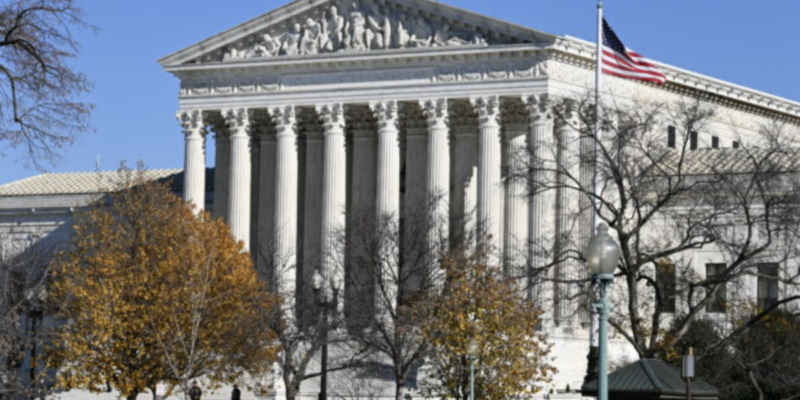

Four years ago, a Texas man was convicted of possessing a gun while also engaging in recreational marijuana use. Yesterday, the United States Supreme Court unanimously voted that this violated his right to bear arms.
The ruling does not mean all drug users can legally own guns. Instead, the court said the government must show more than marijuana use alone to justify denying someone their Second Amendment rights. Justice Neil Gorsuch, who authored the court opinion, said the government had not shown that Hemani’s marijuana use could lead to dangerous or unlawful conduct involving the firearm.
“Apart from pointing to habitual drunkard laws, the government has not even attempted to prove that any other specific historical principle might justify its prosecution in this case,” Justice Gorsuch wrote.
Born in Texas, Ali Hemani is a dual citizen of the U.S. and Pakistan. Federal agents searched his home in 2022 after he and his family were suspected of terrorism-related activity. Hemani surrendered his firearm and disclosed that he possessed marijuana, which he admitted to using recreationally.
Six months later, he was prosecuted for knowingly possessing a firearm while being an unlawful user of a controlled substance. The government argued that the charge alone carried a sentence of up to 15 years in prison and a lifetime ban on possessing firearms.
Although the court ruled in Hemani’s favor, the justices said this decision “does not address efforts to ban addicts or those presently intoxicated from possessing a firearm.”
However, the justices did acknowledge that most states have legalized marijuana to some degree, arguing that the case against Hemani solely focused on his marijuana use.
“Marijuana consumption is increasingly common in this country,” Justice Samuel Alito and Justice Elena Kagan wrote in their concurring opinion. “Many States have legalized its use and sale, and although possession of the drug remains a federal crime, very few persons are convicted of that offense each year.”
In April, the Justice Department reclassified state-licensed medical marijuana to a lesser classification, from Schedule I to Schedule III, reducing some federal restrictions and recognizing it as less dangerous.
Although recreational marijuana remains illegal under federal law, Justice Gorsuch said there is no doubt that it has become more normalized by the American people and the federal government.
“Whatever one thinks of these developments, the federal government has not just tolerated them; it helped fuel them,” he wrote. “All of which leaves it awkwardly positioned to suggest that the millions of Americans who now regularly use marijuana are categorically and unusually dangerous.”